Your Gut Is Not a Silent Bystander – It's Your Health's Command Center
Imagine carrying 2 to 4 pounds of bacteria inside you — roughly 1,000 different species forming an ecosystem that controls your immune system, influences your mood, and determines whether chronic inflammation smolders in your body. That ecosystem is your microbiome, and what you eat decides whether it thrives or withers.
One of the most powerful weapons for a healthy microbiome isn't in your medicine cabinet — it's in the refrigerated aisle: fermented foods. Kimchi, sauerkraut, kombucha, yogurt — what our grandparents ate without a second thought is experiencing a scientific renaissance. And the data is clear: fermented foods increase microbial diversity in the gut and reduce inflammatory markers — measurably, demonstrably, and backed by clinical trials.
What Are Fermented Foods — and What Makes Them So Special?
Fermentation is one of humanity's oldest food preservation methods. Microorganisms — bacteria, yeasts, or molds — convert sugars and starches into acids, alcohol, or gases. The result is not just longer shelf life, but often a more nutrient-dense product than the original.
Here's the crucial difference from merely "shelf-stable" foods: fermentation produces living microorganisms that reach your gut alive. Unlike pasteurized products where all bacteria have been killed, truly fermented foods contain active cultures. These produce short-chain fatty acids (SCFAs) like acetate, propionate, and butyrate in your gut — the primary energy source for your colon cells and key molecules for immune regulation (Leeuwendaal et al., 2022).
Key fermented foods include:
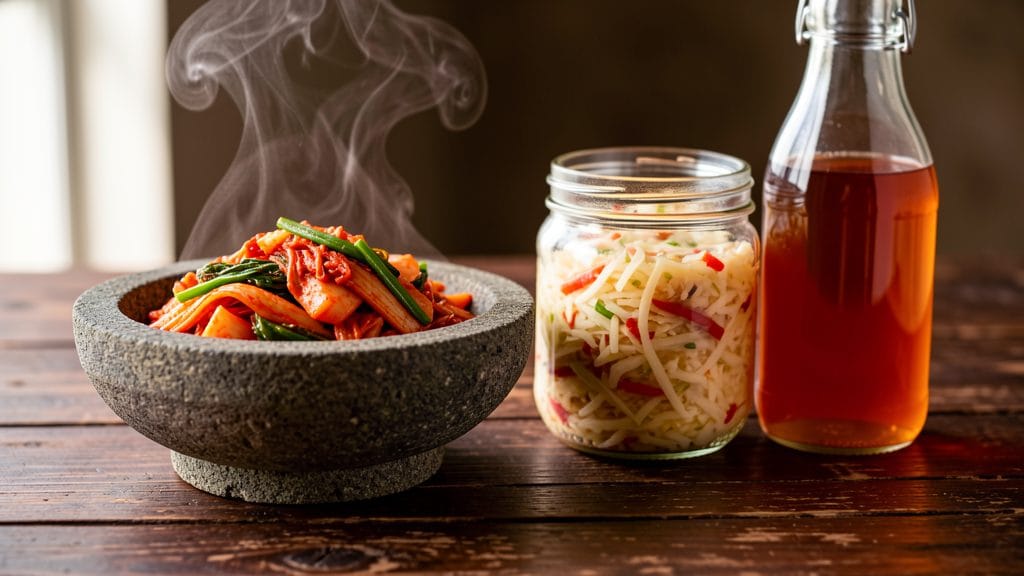
- Kimchi — Korean fermented vegetables (typically napa cabbage and radish, spiced with chili, garlic, and ginger)
- Sauerkraut — Fermented white cabbage, rich in lactic acid bacteria and vitamin C
- Kombucha — Fermented tea with yeasts and acetic acid bacteria
- Yogurt & Kefir — Fermented dairy with Lactobacillus and Bifidobacterium strains
- Miso & Tempeh — Fermented soy products from Japanese and Indonesian cuisine
The Stanford Study: 10 Weeks That Changed Everything
In 2021, a team from the Stanford School of Medicine published a groundbreaking study in the journal Cell that shook nutrition science to its core (Wastyk et al., 2021). The researchers divided 36 healthy adults into two groups: one ate a high-fiber diet for 10 weeks; the other consumed fermented foods daily — yogurt, kefir, kimchi, and kombucha.
The results were stunning. The fermented-food group showed significantly increased microbiome diversity and — even more impressive — 19 inflammatory markers dropped, including interleukin-6, a key driver of chronic inflammation. The fiber group? No reduction in inflammatory markers — even though fiber is undeniably healthy.
What does this mean in practice? It's not enough to just "eat healthy." You need to deliver live bacteria to your gut — and that's exactly what fermented foods do.
How to Strengthen Your Microbiome — A Practical Guide
The good news: you don't need expensive supplements to benefit from fermented foods. The German Nutrition Society (DGE) published a comprehensive microbiome update in 2026, noting that over 36,000 microbiome studies were published in the previous 12 months alone — the field is exploding, and the message is clear: diversity is key.
Here are five simple ways to integrate fermented foods into your daily routine:
- Start small: A tablespoon of sauerkraut or kimchi with your main meal — your gut needs time to adjust to the new bacteria. Too much at once can cause bloating.
- Look for "live" products: Only unpasteurized products from the refrigerated section contain active cultures. If the jar says "pasteurized" — skip it; the bacteria are dead.
- Vary your sources: Kimchi delivers different bacterial strains than kefir, and miso different ones than kombucha. The more diverse your fermented selection, the more diverse your microbiome.
- Combine with fiber: Fermented foods deliver the bacteria; fiber (from whole grains, legumes, vegetables) provides their food. Together, they're an unbeatable team.
- Make your own: Homemade kimchi or sauerkraut often contains more live cultures than commercial products — and it's cheaper.
[Advertisement] Ready to start? Wildbrine Kimchi (organic, live cultures) is an excellent entry point — check it out on Amazon.com. For targeted microbiome support, we recommend Garden of Life Raw Probiotics with 34 probiotic strains — available on Amazon.com.
Conclusion: Your Daily Spoonful of Health
The evidence is overwhelming: fermented foods increase your microbiome's diversity and reduce inflammatory markers — to a clinically measurable degree. The Stanford study proved that just 10 weeks of fermented-food eating makes a significant difference. The science is unanimous: your gut microbiome is the foundation of your health, and fermented foods are one of the most effective ways to nurture it.
You don't need to be a nutrition scientist to benefit. A spoonful of kimchi with lunch, a glass of kefir in the morning, some sauerkraut on your sandwich — small habits with outsized impact. Your gut will thank you — with better digestion, a calmer immune system, and perhaps even a brighter mood. Because what happens in your gut doesn't stay in your gut — it shapes your entire health.
Disclaimer: This article is for informational purposes only and does not replace professional medical advice. Consult your healthcare provider for health concerns.
🍽️ Try it yourself: Get the full Kimchi recipe with step-by-step instructions →