
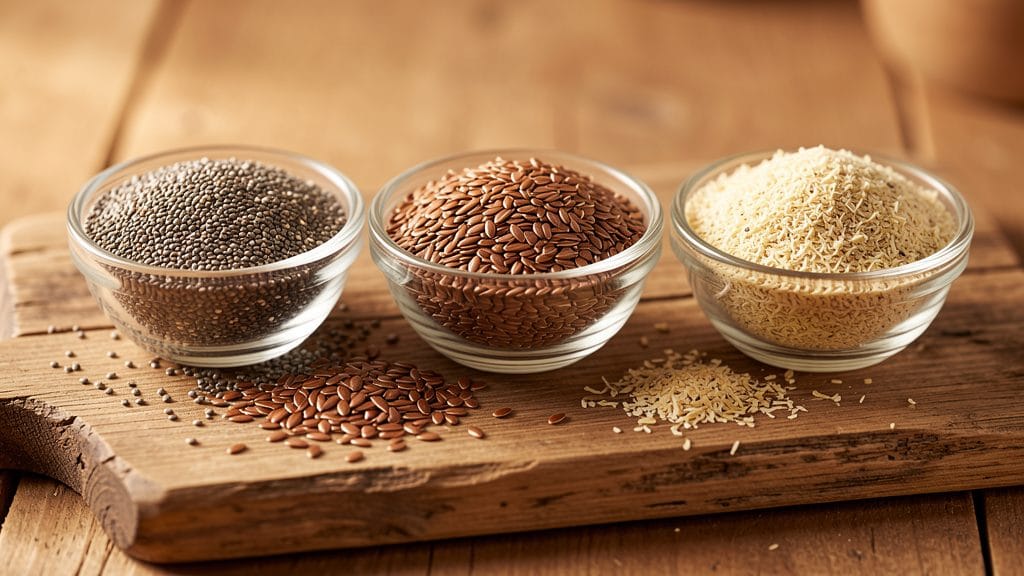
Introduction: Three Seeds, One Goal – Better Digestion and Improved Health
Chia seeds, flaxseeds, and psyllium husks – three small natural products with a big impact. They all provide valuable fiber, promote digestion, and offer healthy fatty acids. But what are the differences? Which seed is right for whom? In this comprehensive chia seed, flaxseed, and psyllium husk comparison, we shed light on the matter – with a nutritional table, clear recommendations, and practical tips for your daily life.
Nutritional Values in Direct Comparison: Chia vs. Flaxseeds vs. Psyllium Husks
The following table shows the most important nutritional values per 100 grams – based on data from the USDA, DGE, and the Verbraucherportal Bayern:
| Nutrient (per 100 g) | Chia Seeds | Flaxseeds | Psyllium Husks |
|---|---|---|---|
| Calories | 486 kcal | 534 kcal | ~170 kcal |
| Protein | 16.5 g | 22 g | ~3 g |
| Fat | 30.7 g | 36.5 g | ~1 g |
| Omega-3 (ALA) | 18 g | 20 g | – |
| Omega-6 : Omega-3 | 1 : 3 | 1 : 4 | – |
| Fiber | 18–30 g | 22.7 g | ~85 g |
| – of which soluble | ~5 g | ~8 g | ~85 g |
| Calcium | 631 mg | 206 mg | ~280 mg |
| Potassium | 407 mg | 731 mg | – |
| Magnesium | 335 mg | 323 mg | – |
| Iron | 7.7 mg | 6.75 mg | – |
| Vitamin E | 0.5 mg | 1.6 mg | – |
Sources: USDA National Nutrient Database, Bechthold 2015, Verbraucherportal Bayern. Values for psyllium husks vary depending on purity – pure husks contain almost exclusively fiber.
1. Chia Seeds – The Calcium Wonder from Overseas
Chia seeds (Salvia hispanica) originally come from Mexico and Guatemala. The name comes from the Mayan language and means "strong" – and rightly so: with 631 mg of calcium per 100 g, they contain five times more calcium than milk. They also lead in iron with 7.7 mg.
Their special characteristic: In liquid, chia seeds form a gelatinous mucilage layer and swell up to 12 times their own weight. This makes them the perfect vegan egg substitute (1 tbsp chia + 4 tbsp water = 1 egg) and the base for the popular chia pudding.
In the EU, chia seeds are considered a Novel Food. The maximum daily dose is 15 g (approx. 1 tbsp). They do not need to be ground – the nutrients are available from whole seeds. However, the long transport routes from South America and Australia make them the ecologically weakest choice among the three candidates.
Our tip: View organic chia seeds 1 kg on Amazon.de →
2. Flaxseeds – The Regional Omega-3 Champion
Flaxseeds have been used since antiquity – even the ancient Egyptians and Romans valued them as a remedy. With 20 g of Omega-3 (ALA) per 100 g, they are the richest plant-based source of Omega-3 available. Their Omega-6 to Omega-3 ratio of 1:4 is almost ideal and helps reduce silent inflammation in the body.
The crucial point with flaxseeds: They must be ground! Whole flaxseeds pass through the intestine undigested – the valuable Omega-3 fatty acids remain trapped. It is best to buy freshly ground organic flaxseeds or grind them yourself in a coffee grinder.
Flaxseeds also work excellently as a vegan egg substitute: 1 tbsp ground flaxseeds + 3 tbsp water create a binding gel. In terms of protein, they are the leader in comparison with 22 g per 100 g. The biggest advantage: Regional cultivation in Germany and Europe makes them the most sustainable and affordable choice – flaxseeds often cost only half as much as chia seeds.
Important: Maximum 20 g per day (approx. 2 tbsp). Some varieties contain cyanogenic glycosides – if there is a warning on the package, heat the seeds before consumption (e.g., bake them in bread).
Our tip: View organic ground flaxseeds 1 kg on Amazon.de →
3. Psyllium Husks – The Fiber King for Digestion
Psyllium seeds (Plantago ovata) are the inconspicuous stars among fiber providers. With 85% soluble fiber, their husks contain almost twice as much as chia and more than three times as much as flaxseeds. If you want to promote your digestion, there are few ways around psyllium husks.
Their superpower: In water, they swell into a gel-like mass that lubricates the intestinal contents and stimulates bowel movements. For constipation, they act as a gentle bulking agent; for diarrhea, they bind excess water. They also bind bile acids and can thus lower cholesterol levels – this effect is best scientifically proven for psyllium husks.
Psyllium husks contain hardly any fat, hardly any protein, and only 17 kcal per 10-g serving. They are tasteless and perfect for thickening smoothies, soups, or for gluten-free baking. Recommended dose: 3 × 5 g daily (maximum 40 g per day), always with at least 1–2 glasses of water.
Our tip: View organic psyllium husks 1 kg on Amazon.de →
Islamic Perspective: Seeds as Signs of Allah
In the Qur'an, seeds are repeatedly mentioned as signs of Allah's creative power:
"Have you seen that which you sow? Is it you who makes it grow, or are We the grower?"
— Qur'an, Surah 56:63-64 (Al-Waqi'a)
The Prophet Muhammad (peace be upon him) explicitly recommended certain seeds as remedies. It is narrated that flaxseeds were recommended for various ailments. The Islamic medical tradition emphasizes the principle of moderation even with healthy foods – a principle that is highly relevant given the maximum recommended amounts for all three seeds. Allah has entrusted us with these gifts; using them with gratitude and reason is part of our responsibility as His vicegerents on Earth.
You can learn more about the Islamic perspective on healthy eating in our article on Magnesium from an Islamic perspective.
Conclusion: Which Seed for Whom?
| Goal | Best Choice | Why? |
|---|---|---|
| 🥇 Omega-3 supply | Flaxseeds | 20 g ALA/100 g, best ω6:ω3 ratio |
| 🥇 Digestion & Cholesterol | Psyllium Husks | 85% soluble fiber, clinically proven |
| 🥇 Calcium & Iron | Chia Seeds | 631 mg Ca/100 g, 7.7 mg Fe/100 g |
| 🥇 Vegan Egg Substitute | Chia / Flaxseeds | Both work perfectly |
| 🥇 Protein | Flaxseeds | 22 g/100 g, more than most legumes |
| 🥇 Sustainability & Price | Flaxseeds | Regional cultivation, often half the price of chia |
| 🥇 Low-calorie swelling | Psyllium Husks | 17 kcal per serving, maximum satiety |
Our Recommendation
For most people in Germany, flaxseeds are the best all-round choice: regional, inexpensive, rich in Omega-3 and protein. Those who specifically want to support their digestion or lower cholesterol levels can supplement with psyllium husks. Chia seeds are a welcome change for puddings and as a calcium boost – but not a must if flaxseeds are already on the menu.
Practical Tips for Everyday Use
- Adhere to daily dosage: Maximum 20 g flaxseeds, 15 g chia seeds, 15–40 g psyllium husks per day.
- Always with liquid: All three seeds absorb water – without sufficient fluid intake, constipation can occur. Drink at least 1–2 large glasses of water after consumption.
- Grind flaxseeds: Whole flaxseeds are useless in the intestine. Buy freshly ground or grind them yourself.
- Start slowly: For sensitive intestines, increase the dose over 1–2 weeks to avoid bloating.
- 30 minutes apart from medication: The bulking agents can impair the absorption of medication.
- Not suitable for: Intestinal obstruction, swallowing difficulties, acute gastrointestinal inflammation.
Note: This article is for informational purposes only and does not replace medical advice. If you have existing conditions or are taking medication, consult your doctor before changing your diet.
The article contains affiliate links. If you make a purchase through these links, we receive a small commission – the price for you remains unchanged. Thank you for your support!