
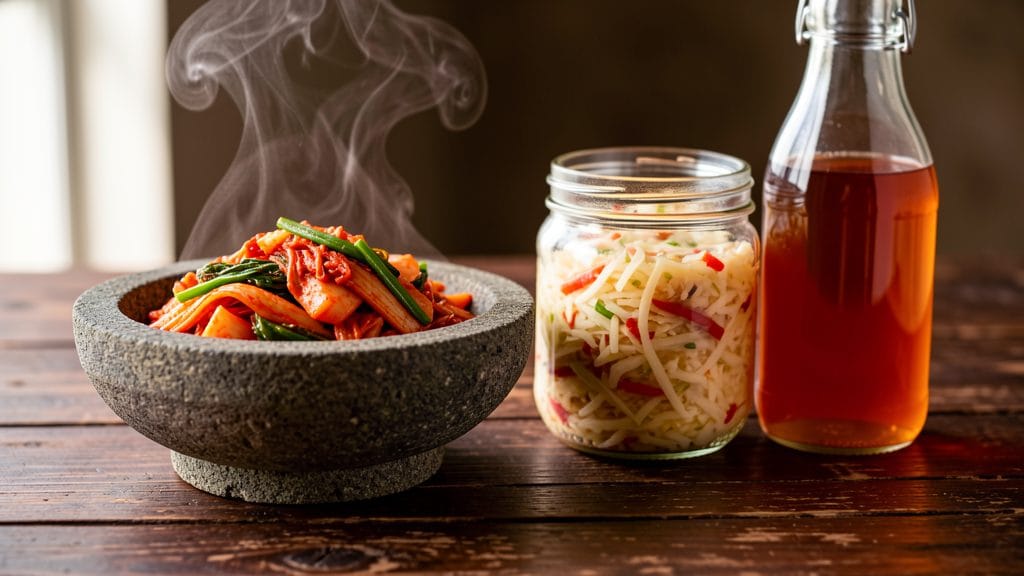
Your Gut Isn't a Silent Spectator – It's the Command Center of Your Health
Imagine carrying 1 to 2 kilograms of bacteria inside you – about 1,000 different species that together form an ecosystem controlling your immune system, influencing your mood, and determining whether chronic inflammation smolders in your body. This ecosystem is called the microbiome, and what you eat dictates whether it thrives or withers.
One of the most powerful weapons for a healthy microbiome isn't found in the medicine cabinet, but in the refrigerated section: fermented foods. Kimchi, sauerkraut, kombucha, yogurt – what our grandparents ate as a matter of course is now experiencing a scientific renaissance. And the data is clear: fermented foods increase microbial diversity in the gut and reduce inflammatory markers – measurably, demonstrably, and proven in clinical studies.
What Are Fermented Foods – and Why Are They So Special?
Fermentation is one of the oldest methods of food preservation. Microorganisms – bacteria, yeasts, or molds – convert sugar and starch into acids, alcohol, or gases. The result is not only longer-lasting but often more nutrient-rich than the original product.
The crucial difference from simply "shelf-stable" foods is that fermentation produces living microorganisms that reach your gut alive. Unlike pasteurized products, where all bacteria have been killed, truly fermented foods contain active cultures. These produce short-chain fatty acids (SCFAs) in the gut, such as acetate, propionate, and butyrate – the primary energy source for your colon cells and key molecules for immune regulation (Leeuwendaal et al., 2022).
Key fermented foods include:
- Kimchi – Korean fermented vegetables (mostly napa cabbage and radish, seasoned with chili, garlic, and ginger)
- Sauerkraut – fermented white cabbage, rich in lactic acid bacteria and vitamin C
- Kombucha – fermented tea with yeasts and acetic acid bacteria
- Yogurt & Kefir – fermented dairy products with Lactobacillus and Bifidobacterium strains
- Miso & Tempeh – fermented soy products from Japanese and Indonesian cuisine, respectively
The Stanford Study: 10 Weeks That Changed Everything
In 2021, a team from the Stanford School of Medicine published a groundbreaking study in the journal Cell that profoundly shook nutritional science (Wastyk et al., 2021). Researchers divided 36 healthy adults into two groups: one ate a high-fiber diet for 10 weeks, while the other consumed fermented foods daily, such as yogurt, kefir, kimchi, and kombucha.
The result was a sensation: the fermented food group showed significantly increased microbiome diversity, and – even more impressively – 19 inflammatory markers were reduced, including interleukin-6, a central driver of chronic inflammation. The fiber group, however: no reduction in inflammatory markers – even though fiber is undeniably healthy.
What does this mean practically? It's not enough to simply eat "healthy." You need to supply your gut with living bacteria – and that's exactly what fermented foods do.
How to Strengthen Your Microbiome – Practically
The good news: you don't need expensive supplements to benefit from fermented foods. The German Nutrition Society (DGE) published a comprehensive update on microbiome research in 2026 and emphasizes: over 36,000 studies on the microbiome have been published in the last 12 months alone – the field is literally exploding, and the message is clear: diversity is key (DGE, 2026).
Here are five simple ways to integrate fermented foods into your daily life:
- Start small: A tablespoon of sauerkraut or kimchi with your main meal – your gut needs time to adjust to the new bacteria. Too much at once can lead to bloating.
- Look for "live": Only unpasteurized products from the refrigerated section contain active cultures. If the jar says "pasteurized" – steer clear, the bacteria are dead.
- Vary your sources: Kimchi brings different bacterial strains than kefir, miso different than kombucha. The more diverse your fermented selection, the more diverse your microbiome.
- Combine with fiber: Fermented foods provide the bacteria, fiber (from whole grains, legumes, vegetables) provides their food. Together, they are an unbeatable team.
- Make your own: Homemade kimchi or sauerkraut often contains more live cultures than industrial products – and is cheaper. → Find our kimchi recipe here.
[Advertisement] If you want to get started right away: Fairment Kultur Kimchi (vegan, organic, in a jar) is a live fermented kimchi that ripens unrefrigerated and contains no artificial additives – view on Amazon.de here. For targeted support, we recommend the Naturwohl Probiotika Kulturen Komplex with 20 bacterial strains – view on Amazon.de here.
Islamic Perspective: The Gut as a Trust
In Islam, the body is considered a trust for which we are accountable to Allah. Prophet Muhammad (peace be upon him) taught moderation in eating: "The son of Adam does not fill any vessel worse than his stomach. A few morsels are sufficient for the son of Adam to keep his back straight." (Sunan Ibn Majah 3349).
This restraint perfectly aligns with modern microbiome research: it's not the quantity of food that matters, but its quality and diversity. Fermented foods like yogurt and pickled vegetables have a millennia-old tradition in the Islamic world. Ibn Sina (Avicenna) himself, the namesake of this portal, recommended fermented dairy products in The Canon of Medicine to strengthen digestion – knowledge that science today confirms at a molecular level.
The Quranic verse "Eat of the good things We have provided for you" (2:172) encourages us to consciously choose what we put into our bodies. In this sense, fermented foods are not only "permissible" but actively health-promoting.
Conclusion: Your Daily Spoonful of Health
The evidence is overwhelming: fermented foods increase the diversity of your microbiome and lower inflammation levels – to a clinically measurable extent. The Stanford study showed that just 10 weeks of a fermented diet can make a significant difference. The DGE confirmed in 2026: the microbiome is the hottest field in nutritional research, and the message is clear.
You don't have to be a nutritionist to benefit. A spoonful of kimchi with lunch, a glass of kefir in the morning, some sauerkraut on bread – small habits with a big impact. Your gut will thank you – with better digestion, a calmer immune system, and perhaps even a better mood. Because what happens in your gut doesn't stay in your gut – it shapes your entire health.
Disclaimer: This article is for informational purposes only and does not replace medical advice. For health concerns, please consult a doctor or nutritionist.
🍽️ Try it yourself: To the kimchi recipe with step-by-step instructions →