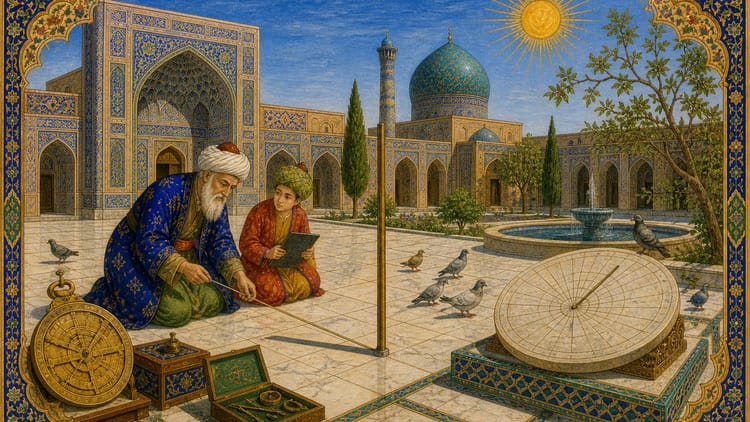
The Years of Ibn Sina · Chapter 2. A new chapter every other Thursday. Click here for Chapter 1.
The Answer Behind the Curtain
There are moments when a child is older than the adults around them, and moments when the child realizes it. For al-Husain, son of Abdallah, both came together on that evening when a guest asked where the soul resides, and no one answered.
The curtain behind which he lay was made of coarse wool, woven in the pattern of the carpet weavers of Balch, red and dark blue, and at one spot, level with his face, it was so worn thin that the light of the oil lamp shone through like a cloud. Through this cloud, he had watched the men on many evenings: their beards, their hands drawing circles in the air as they spoke, the tea bowls growing cold on the cloth between them because no one thought of them anymore. By now, he knew their voices better than their faces. One spoke softly and slowly, as if counting every word before letting it go. Another spoke quickly and laughed between sentences. And the third, the one who had asked the question, only spoke when he believed he could say something that would silence the others.
Al-Husain pushed the curtain aside and stepped into the circle of light.
His father raised his eyebrows. Mahmud, the little brother, who had fallen asleep on a cushion in the corner, did not stir. The three guests looked at the boy the way one looks at a bird that has flown into the room: surprised, a little amused, and with the quiet certainty that it will soon flutter out again.
“If the soul sat in the heart,” said al-Husain, “then a man who loses an arm in battle would lose part of his soul. But he remains the same. He remembers everything. He loves the same people. So the soul can’t be in pieces inside him, like grain in a sack.”
It grew so quiet that you could hear the oil crackling in the lamp.
The quick guest was the first to laugh, but it was a different laugh than usual, shorter, breaking off halfway. The quiet one leaned forward. “And where does it sit, little scholar?”
“I don’t know,” said al-Husain. “But I know your answer isn’t right.”
Abdallah sent him to bed, his voice holding as much pride as sternness. But as the boy drew the curtain behind him again, he heard that the men did not resume their conversation, but began a new one. Now they spoke of things that could be measured. Of geometry, where a triangle has the same angles everywhere in the world, whether you draw it in the sand in Bukhara or on papyrus in Cairo. And of a way of calculating with nine symbols and a tenth that meant nothing at all, yet changed everything.
Al-Husain lay awake for a long time that night. He no longer thought of the soul. He thought of the symbol that meant nothing.
Later, when he was an old man dictating his life to a student, he described those evenings in a single sentence, as sober as a prescription: He had understood what the guests said, but his soul had not accepted it. What he did not say was that something else began on those nights. He had discovered that you can contradict a claim without having a better one. And that you must keep searching.
The Market in the Morning
A few days later, his father took him by the hand and led him to the bazaar. It was the year 380 of the Hijra, 990 by the Christian calendar, and autumn had covered the city in a light that made everything look older than it was.
Anyone who only knew Bukhara from the outside, from the mud walls that encircled the city like rings around a tree trunk, had no idea what was inside. Inside, it was a crush of people. The alleys were so narrow that two loaded donkeys could only pass each other with shouting and shoving, and mats of reed hung over the lanes, keeping out the summer and, in autumn, slicing the light into stripes so that everyone walking through looked like a tiger. Canals ran through the city, fed by the Serafshan River, whose name means “the gold scatterer,” and along their banks stood mulberry trees under which children ate the black fruit until their mouths looked as if they had drunk ink.
Above everything rose the citadel, the seat of the emir, a mound of walls so old that no one remembered who had laid the first stone. And on the edge of the city, among gardens, stood the mausoleum of the Samanids, a cube of fired bricks so artfully set that the building changed its face over the course of a day: pale as bread in the morning, almost white at noon, and as red as the embers in an oven by evening. People said that anyone who had seen it at sunset would never want to live in a mud house again. Most did anyway.
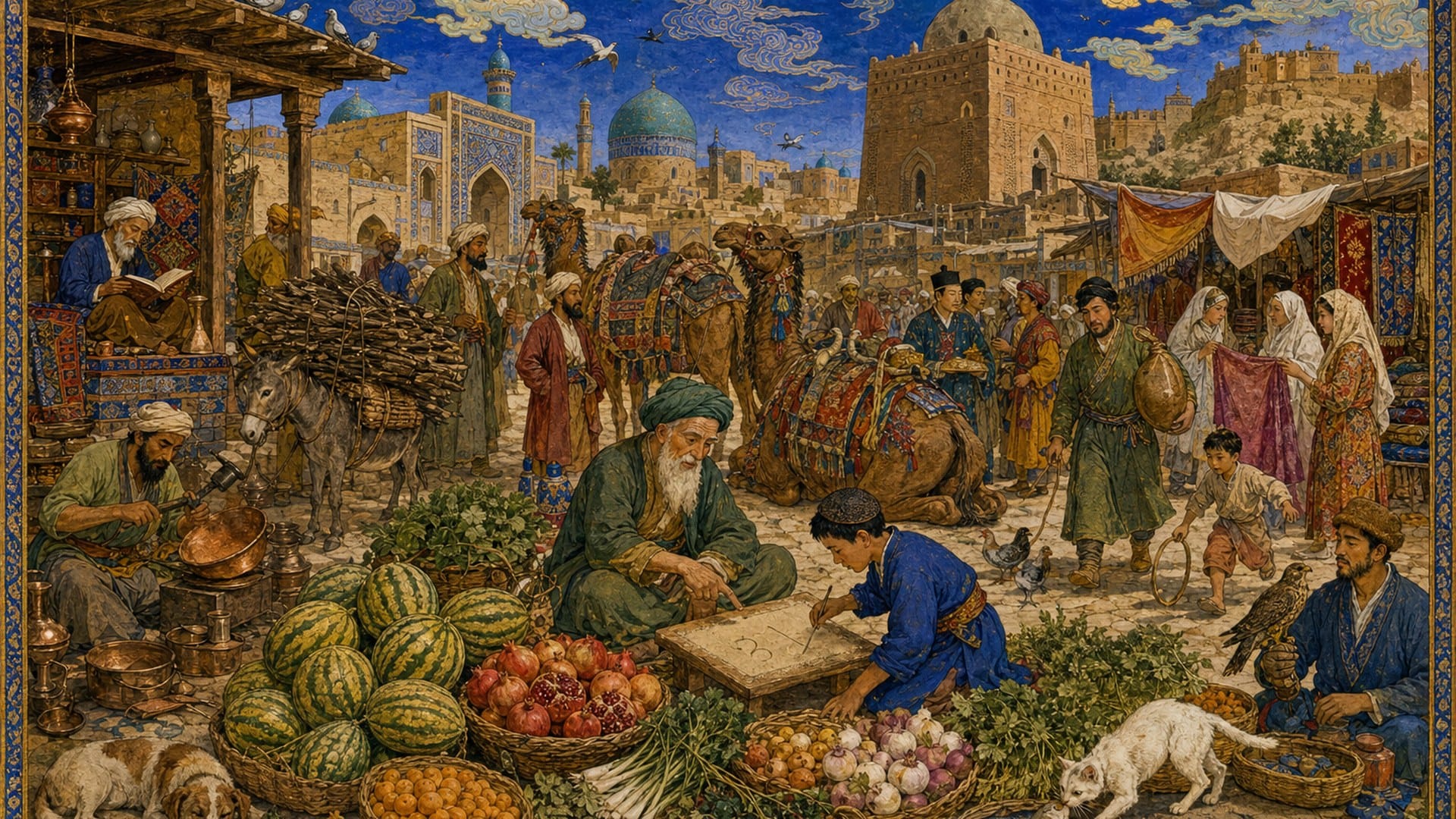
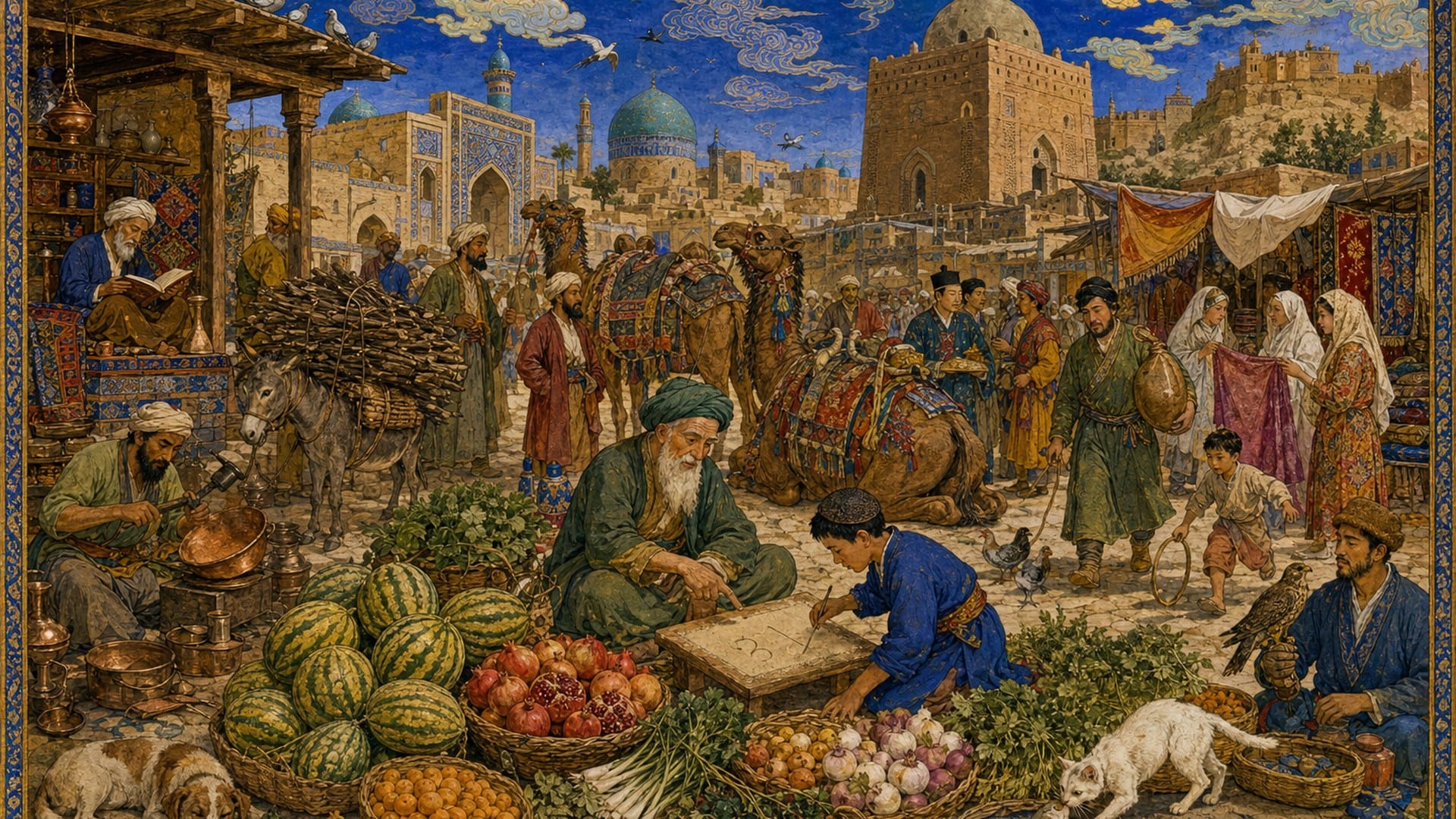
The bazaar smelled of everything at once. Of cumin and horse manure, of fresh bread from the clay ovens, of the leather of the saddlers and the smoke of the coppersmiths, who hammered their pots into shape, blow after blow, so evenly that you could have measured time by them. Merchants from China offered silk and porcelain so thin you could see the light through the rim of a bowl. Merchants from India sat among sacks of pepper and cinnamon bark and fabrics in colors for which Bukhara had no names yet. Water carriers moved through the crowd with bulging goatskins, calling out their price, and a falconer paraded a bird with a leather hood as if it were a prince touring his city in disguise.
And then there were the melons.
It’s necessary to speak of the melons, because in that region they were not just an ordinary fruit, but almost a currency. From Khwarezm, the land at the lower reaches of the Oxus, came melons whose reputation reached as far as the caliph’s court in Baghdad. A chronicler of that time reports that they were sent there packed in lead containers filled with snow so they would survive the weeks-long journey. Imagine it: caravans crossing deserts, over passes and along rivers, loaded with snow in which a melon slept like a gemstone in a casket, just so a caliph in Baghdad could bite into something cool and sweet in the height of summer. There are few things that reveal more about an age than the effort it puts into its pleasures.
The man to whom Abdallah led his son did not sell such melons. His were smaller, striped like the porters’ tunics, and came from gardens outside the city. Beside them he piled pomegranates, beets, onions, bundles of dill and coriander, baskets of dried apricots. His name, let’s call him that, was Ja’far, and he was a man of indeterminate age, with a white beard that turned yellow where he twisted it between his fingers in thought, and a green turban which, he claimed, he had not washed since his wife died, because she had been the last to do it properly.
But Ja’far was not famous for his beets.
Nine Symbols and an Empty Circle
Beside his baskets, in the shade of the reed mat, lay a flat board of walnut wood, barely larger than a child’s prayer rug, with a low rim all around. On the board was fine, pale dust, as fine as flour. Ja’far smoothed it with his hand until it shone, took a thin reed stick, and wrote in it.
“This,” he said, without looking up, “is the merchants’ arithmetic. Long before your grandfather was born, clever men in Baghdad wrote it down in books. One of them came from not far from here, from Khwarezm. His name was al-Khwarizmi. But you don’t need books for this. You need dust, a stick, and a head that doesn’t sleep.”
He drew nine symbols in the dust, one after the other. Al-Husain knew arithmetic as it was done in his father’s offices: with letters that were also numbers, with fingers bent into certain positions to keep track of tens and hundreds, with long columns where a single mistake could ruin an entire tax list. He had seen the clerks sweat over it.
Then Ja’far drew a tenth symbol. A small circle.
“And this?” asked al-Husain.
“That is nothing,” said Ja’far. “The Arabs call it sifr, the empty. It stands where there is nothing.”
“Why write something where there is nothing?”
The old man smiled for the first time, and you could see he was missing two teeth, upper left, like two empty spots in a number. “Because nothing needs a place, boy. Look.” He wrote a one and next to it the circle. “Ten.” He wrote a one and two circles. “A hundred.” He wiped away one circle with his thumb. “Back to ten. The value of a symbol depends on where it stands. The one on the far right is a one. Move it one place to the left, and it’s worth ten times as much. And the empty keeps its place, so it doesn’t slip back.”
Al-Husain stared at the dust. Something inside him, which until then had sat in a chamber, stood up and opened a window.
Today, it’s hard to grasp what this way of calculating meant, because we absorb it with our mother’s milk. But in those years, it was a revolution that began quietly in the bazaars, among people like Ja’far, who needed to know in an instant what forty-three beets at seven copper coins each cost if the customer returns two and pays for the rest with a chicken. With the nine symbols and the empty, a greengrocer could calculate in a breath what a scholar with letter-numbers needed half an hour for. The dust was not a makeshift, but a tool of great elegance: you wrote, you calculated, you swept your hand over it, and the mistake was gone as if it had never existed. The scholars called it dust arithmetic. Only centuries later, when these symbols reached Europe via Spain and Italy, would merchants in Florence and Pisa call them “Arabic numerals” and argue whether they could be trusted, since a zero could so easily be turned into a six. But that is another story, and Ja’far would have just laughed at it.
Al-Husain came back the next day. And the day after that. He sat among the baskets while Ja’far weighed beets and haggled with women over pomegranates, and calculated in the dust. He calculated how much a camel could carry if you loaded it with four sacks of rice and each sack weighed a third more than a child. He calculated how many bricks were in the Samanid mausoleum, counting only the visible ones, and came up with a number Ja’far thought made up, until he checked and fell silent. He calculated how many days a letter took to reach Baghdad and how many melons fit in a box of snow. A white cat, belonging to a neighboring fishmonger who didn’t know it, lay down every noon right in the middle of the board and, with a single contented roll, destroyed the work of an entire morning. Al-Husain learned not to chase her away. He learned to keep the calculation in his head until the cat left again.
After a few weeks, Ja’far said to Abdallah, when he came to pick up his son in the evening: “Take him with you. I have nothing more to teach him. If he stays any longer, he’ll start checking my prices.”
The Ascetic
A boy who can calculate like that, his father believed, above all needs one thing: a foundation to support him when his mind moves too fast. And so Abdallah next sent him to a man known throughout the city only as “Ismail the Ascetic.”
Ismail taught jurisprudence, the knowledge of what is permitted and what is not, how to inherit and how to divide, how a contract becomes valid and when an oath is binding. He was a gaunt man who ate so little that his students bet on whether he ate at all, and who taught in a room that contained nothing but a mat, a water jug, and a shelf of books—not even a carpet. Whoever came to him sat on the bare floor. In winter, it was said, only the truly eager came for that reason.
But Ismail did not only teach what was in the books. He taught how to argue. In the schools of that time, debate was considered a high art. A teacher would make a claim, and the students had to attack it—with questions, objections, counterexamples, following strict rules, just as two fencers cross blades by fixed rules. Whoever asked had to ask precisely. Whoever answered could not evade. And whoever found a flaw in another’s chain could not gloat, but had to show how to repair the chain.
It was as if the boy behind the curtain had finally been allowed to speak out loud.
Al-Husain became, as he later said himself, one of the most skillful questioners. He learned not to attack a claim where it is strongest, but where it is quietest, at the point its defender glosses over most quickly. He learned that the most dangerous question is often the simplest. And he learned that if you have just refuted an older student, it’s best not to look at him if you don’t want to make an enemy. He forgot this last lesson more often than was good for him.
Ismail watched him with an expression his students could not interpret. Once, after a lesson in which al-Husain had tangled three older students in contradictions one after another, the ascetic kept him back.
“You like to win,” he said.
“I was right,” said al-Husain.
“That’s not the same.” Ismail poured water from the jug into a bowl and handed it to him. “A man who only wants to win stops asking as soon as he’s won. A man who wants the truth keeps asking, even after he’s won. Especially then. Remember that. One day you’ll have no one left to contradict you. Then you’ll have to do it yourself.”
Al-Husain drank the water. He was eleven or twelve years old and didn’t quite understand the sentence. But he remembered it, as he remembered everything. It would be decades before he truly understood it.
The Stranger with the Scrolls
One evening in late autumn, as the swallows made their last circles above the rooftops before disappearing south, a rider came into the alley where Abdallah’s house stood. He rode a mule so dusty its color could not be seen, and behind him plodded a second animal, loaded with leather chests and baskets from which the ends of scrolls stuck out like bread from a baker’s basket.
The man was tall and gaunt, with a dark beard full of road dust, and eyes that examined everything as if to catalog it: the gate, the courtyard, the fig tree, the pool where the first stars floated. He dismounted, placed his hand on his heart, greeted Abdallah, who came to meet him, with the greeting of peace, and gave his name. Abu Abdallah al-Natili. He had come, he said, from far away, and he was learned in philosophy.
Al-Husain stood behind the carved door to the women’s courtyard, which was ajar, and Mahmud stood behind him, clutching his robe. The boy watched the servants unload the chests. He saw one of the baskets tip over and a scroll fall out, unrolling a little as it hit the ground and lying there in the light of the lantern that had just been lit. The parchment was yellow and frayed at the edges like an old hem. There were no letters on it, but circles intersecting, lines radiating from points, triangles with smaller triangles inside them like children in their mothers’ arms.
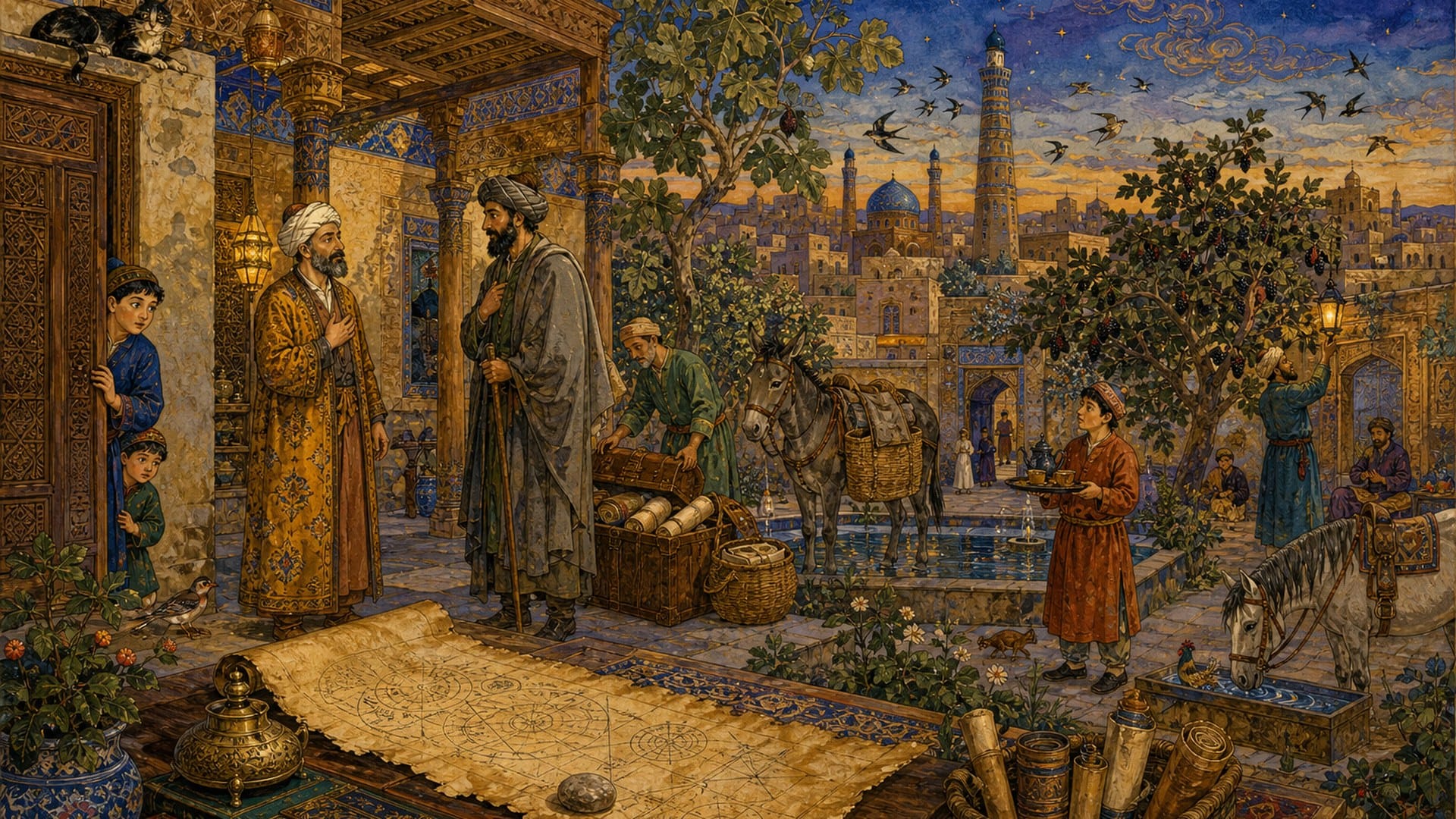
Al-Natili picked up the scroll, blew the dust off, and carefully rolled it up again, as if binding a wound.
Then Abdallah said something al-Husain could hardly believe at first. “You will stay with us,” he told the stranger. “As long as you wish. I ask only one thing: Teach my son.”
Al-Natili turned his head. His gaze wandered across the courtyard, the pool, the fig tree, until it rested on the carved door. On the crack. On the eye behind it.
“Tomorrow,” he said, without looking away, “we’ll start with logic. With the question of what a genus is.”
He smiled as teachers do who think they know what’s coming.
He did not know.
To be continued in two weeks, on Thursday, October 29: Chapter 3, “The Teacher Who Became a Student.”
Body Knowledge from This Chapter: Why Children Learn So Quickly
That al-Husain, at ten years old, mastered a new way of calculating in just a few weeks is unusual, but not mysterious. The child’s brain is built for learning. In the first years of life, it forms far more connections between nerve cells than it will later keep. Then a long remodeling begins, lasting well into adolescence: connections that are used often are strengthened and wrapped in an insulating sheath that transmits signals faster. Connections that are rarely used are pruned away. So a child’s brain literally shapes itself according to what it does. Whoever calculates, reads, or plays an instrument every day builds the pathways for it. Adults also learn throughout life, just more slowly and with more repetition. The ascetic’s advice therefore also applies to the brain: Don’t stop asking questions, even when you think you’ve already won.
What Is True, What Is Told?
From Ibn Sina’s own autobiography: Father and brother listened to the recruiters of the Ismaili movement; the boy understood their doctrine, but “his soul did not accept it.” The guests also spoke of philosophy, geometry, and arithmetic. Afterwards, his father sent him to a greengrocer who used this way of calculating, and he learned it from him. Then he studied jurisprudence with Ismail the Ascetic and, by his own account, became one of the best questioners, skilled in objection and refutation in the manner of the disputants. Then Abu Abdallah al-Natili came to Bukhara, presenting himself as a philosopher, and the father took him into his house to teach the son.
From the history of the time: arithmetic on the dust board, the word sifr (“empty”) for zero, the book by al-Khwarizmi from Khwarezm on calculating with nine symbols and the zero, the melons from Khwarezm, which according to the chronicler ath-Tha’alibi were sent to the caliph’s court in Baghdad in lead and snow, the Samanid mausoleum and the citadel of Bukhara.
Told: the name and character of the greengrocer (“Ja’far” is invented; in the autobiography he remains nameless), the scene in which the boy contradicts the guests, all dialogues, the white cat, the conversation with Ismail about winning, and the arrival of al-Natili with the scrolls. The year 380 of the Hijra (990) is an approximation; the autobiography gives no exact dates for these years.
Sources:
- Sīrat ash-Shaykh ar-Ra’īs, Ibn Sina’s own autobiography in Arabic, dictated to his student Abu Ubaid al-Juzjani and continued by him (11th century)
- Ibn Abi Usaibi’a, Uyūn al-Anbā’ fī Tabaqāt al-Atibbā’ (“Sources of Information on the Classes of Physicians”), Damascus, 13th century, with the text of the autobiography
- Jamal ad-Din al-Qifti, Ta’rīkh al-Hukamā’ (“History of the Scholars”), Aleppo, 13th century
- Zahir ad-Din al-Baihaqi, Tatimmat Siwān al-Hikma, Khorasan, 12th century
- Nizami Arudi Samarqandi, Chahar Maqala (“Four Discourses”), Persian, 12th century
- Abu Bakr an-Narshakhi, Tārīkh-i Bukhara (“History of Bukhara”), 10th century, Persian version 1128: city, citadel, and canals
- Abu Mansur ath-Tha’alibi, Lata’if al-Ma’arif, Nishapur, 11th century: the melons from Khwarezm
- Modern critical edition of the autobiography: W. E. Gohlman, The Life of Ibn Sina, 1974