
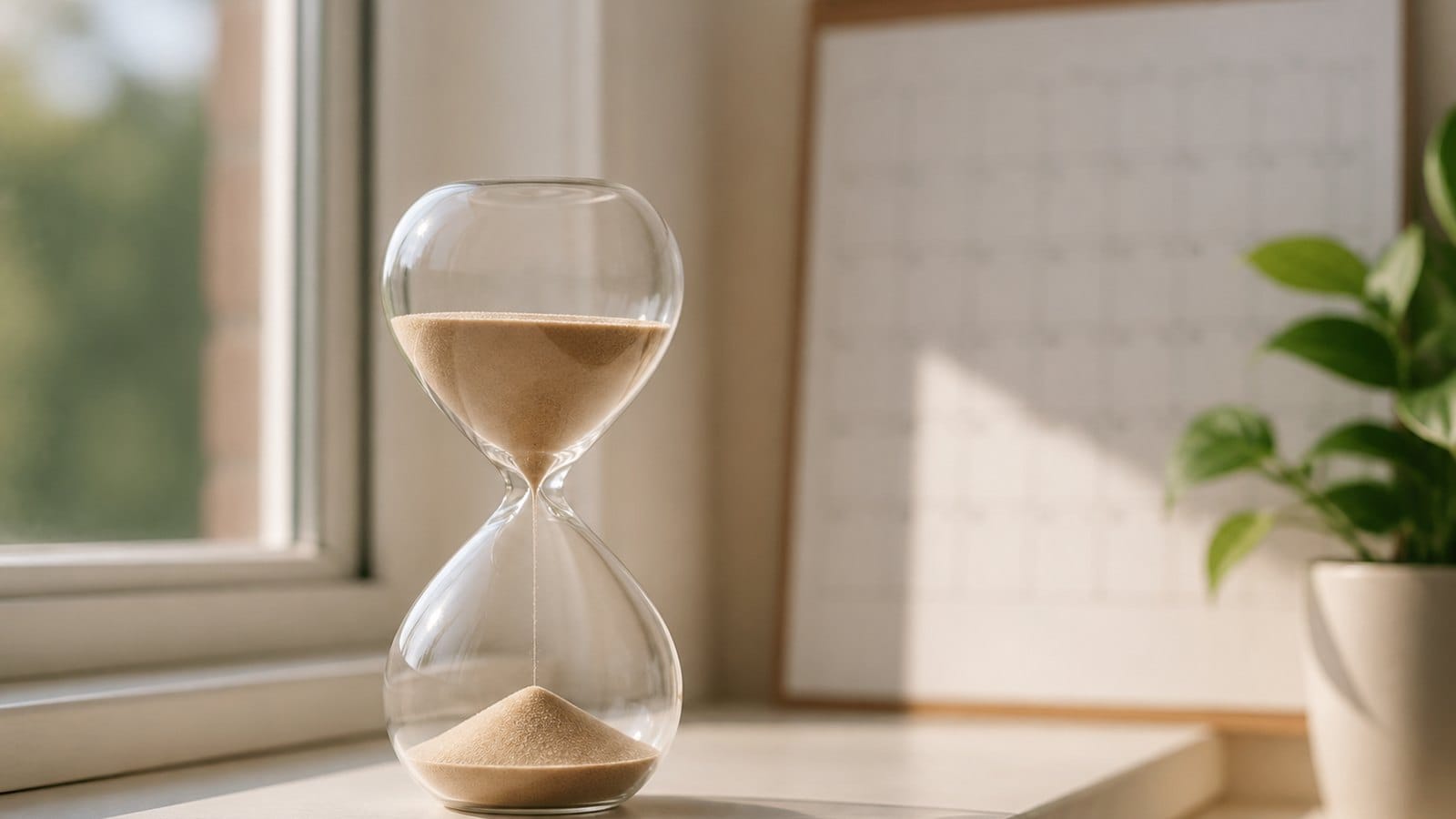
As a child, summer vacation seemed to last forever. These days, it feels like it was just January, and suddenly Christmas is around the corner. Almost every adult knows this feeling — and it only gets stronger with each passing decade.
Of course, the clock isn’t ticking any faster. What changes is the way your brain measures time in retrospect.
Your brain measures time in memories, not in minutes
When it comes to the length of a past period, the brain doesn’t use a stopwatch. Instead, it estimates based on how many distinct memories it can find from that time. Lots of new experiences mean: that must have been a long stretch. Few memories mean: it went by quickly.
For a child, almost everything is new — the first day of school, the first time at the beach, the first bike ride without training wheels. Each of these moments gets its own special place in memory. A year full of firsts leaves behind a thick album.
At forty, one Tuesday looks just like the Tuesday before. Same route, same job, same dinner. The brain saves itself the effort and files away a single memory for a hundred similar days. In hindsight, months shrink down to just a few snapshots.
The vacation paradox
You notice this most clearly when you travel. A week in a new city flies by while you’re in the middle of it. Back home, it feels like it lasted half a month — so much happened.
The week at the office before that was the exact opposite: each day dragged on, and in retrospect, it’s almost wiped from memory. Time that feels long in the moment is often short in hindsight — and vice versa. Boredom stretches the present, novelty stretches the memory.
A year becomes a smaller and smaller part of your life
There’s also a simple calculation, described as far back as the 19th century: for a ten-year-old, a year is a tenth of their entire life. For a fifty-year-old, it’s a fiftieth. Compared to everything you’ve already experienced, each new year becomes proportionally smaller.
Both explanations don’t contradict each other. The calculation describes the feeling; the thing with memories explains how it happens in your mind.
What you can do about it
The good news: if it’s all about the number of memories, you can stretch your sense of time again. Not by adding more hours, but by adding more variety.
- Learn something new. An instrument, a language, a craft. Learning forces your brain to pay close attention and leaves behind vivid memories.
- Change up your routines. Take a different route to work, try a new café, explore an unfamiliar part of town on the weekend. Small changes are enough.
- Make days distinct. If every evening looks the same, they blur together. Setting aside one evening a week for something different creates markers.
- Be mindful instead of distracted. What you do absentmindedly while looking at your phone barely gets stored. What you experience consciously, sticks.
- Capture moments. A few lines in the evening or a photo a day give your memory anchors. Looking back, you’ll realize how much fit into a single month.
The year won’t actually get longer. But in hindsight, it’ll feel like you truly lived it — not just passed through it.
The video on this topic
Which year felt the longest to you in retrospect — and what was different about it? Feel free to share in the comments.