
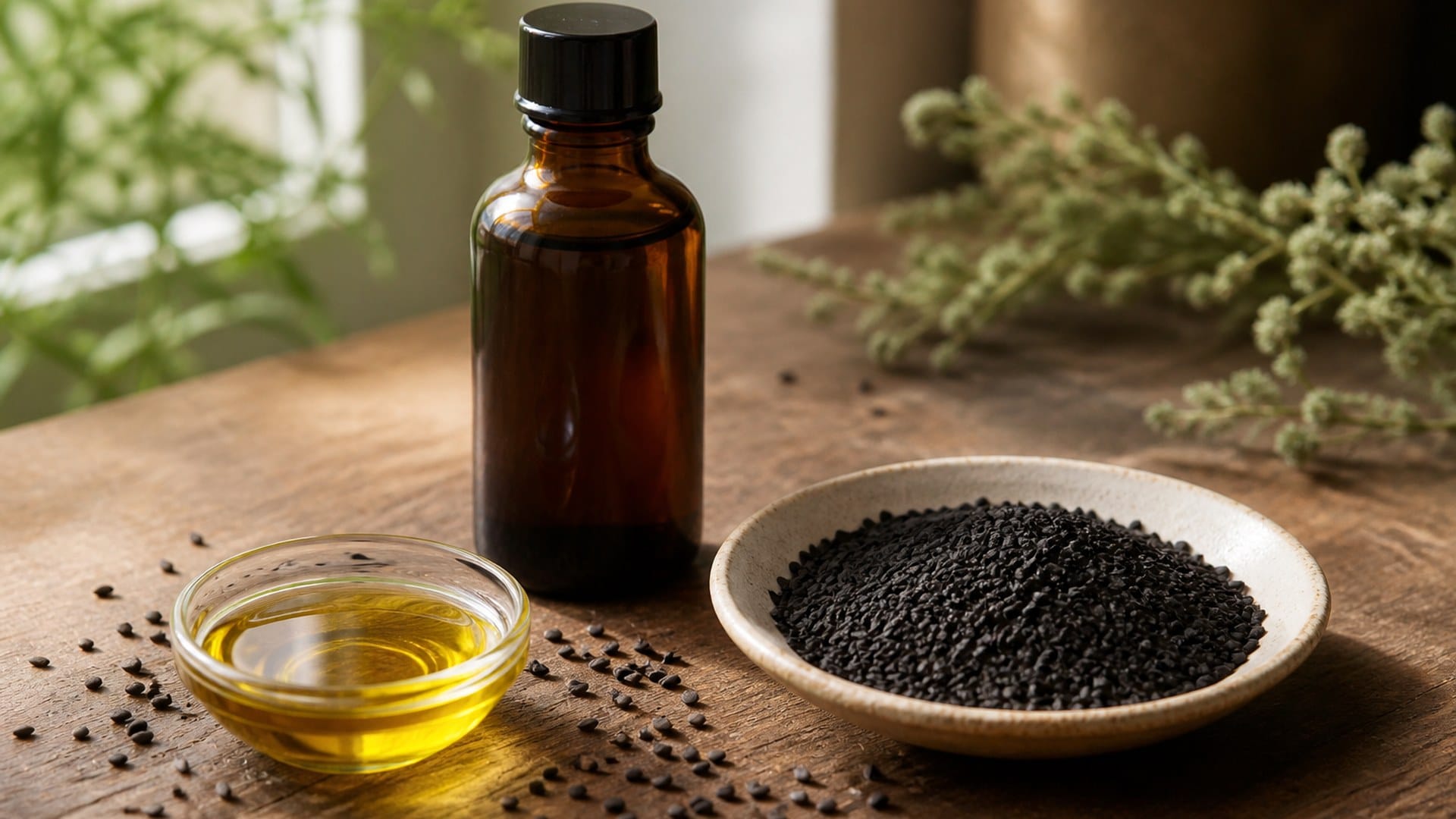
In short: Whether filtered or unfiltered is mainly a matter of taste and shelf life. Many shops claim that unfiltered black seed oil contains more active ingredients. However, there is no study that has measured this for black seed oil. The differences between individual oils are much greater, and you can spot them by looking at the label, bottle, date, and smell.
| Filtered | Unfiltered (cloudy) | |
|---|---|---|
| Appearance | clear, dark gold to amber | cloudy, with sediment |
| Taste | spicy-hot, somewhat milder | stronger, more bitter |
| Shelf life | generally longer | generally shorter, suspended particles contain water |
| More active ingredient? | not measured for black seed, so unproven | |
| Best for | salads, bread, those who prefer a milder taste | those who want the full flavor and use up the oil quickly |
What really distinguishes filtered from unfiltered
During pressing, fine suspended particles from the seeds get into the oil. If they remain, the oil is cloudy and forms sediment at the bottom of the bottle. Filtering removes these particles. Both types can be cold-pressed and of good quality.
Advertising often claims that unfiltered oil is “more natural” and “more valuable.” But for black seed oil, no one has compared filtered and unfiltered oil for the main active ingredient, thymoquinone. There is a clue from another oil: with hemp oil, the filtered version was more stable in storage, turning sour and rancid more slowly. Researchers suspect that the water in the suspended particles speeds up aging. This can’t be transferred one-to-one, but it fits with experience: You should use up unfiltered oil more quickly.
How to recognize good black seed oil
The differences between individual oils are huge. In a Swiss study, the thymoquinone content of six commercial oils varied by a factor of 18; in Turkish market samples, even by a factor of 180. This value is almost never listed on the label. Still, you can check these five things:
- “Cold-pressed” is stated on the label. This is defined in the German guidelines for edible oils: only mechanically pressed, no heat, no additives. “First pressing,” on the other hand, is not a protected term for black seed oil.
- Dark bottle. Brown or violet glass, not clear glass, not plastic. Light and heat break down thymoquinone; in a storage trial, up to 97 percent was lost.
- Fresh date. The best-before date should be as long as possible, ideally with a pressing date. Small bottles that you use up within a few weeks are better than a large stock bottle.
- The manufacturer discloses values. Good suppliers state the thymoquinone content or provide a test report: peroxide value (guideline below 15), acid value, plus residues such as PAHs and pesticides.
- Smell and taste. Good oil smells spicy, slightly pungent, and tastes bitter. If it smells rancid, fishy, or smoky: do not use. And a price far below the usual is a warning sign.
Is black seed oil from Turkey better?
Turkish black seed oil has a good reputation, and black seed has been cultivated in Turkey for a long time, for example in Central Anatolia. However, the studies are contradictory. One study found slightly more thymoquinone in Turkish seeds than in Egyptian ones, but only tested one sample per country. Another found the Turkish sample at the lower end. A third shows that even within Turkey, the content varies tenfold depending on the variety.
The bottom line: Variety, harvest, storage, and pressing matter more than the country of origin. A good Turkish oil from a fresh harvest can be excellent. But a study from Turkey itself urges caution: of 40 oils from the local market, five were probably adulterated with rapeseed or soybean oil. So for oil from Turkish supermarkets, the same five criteria as above apply, especially date, dark bottle, and a realistic price.
By the way, most of the black seed oil sold in German stores comes from Egypt.
Contaminants: what testing authorities look for
The State Office for Consumer Protection in Lower Saxony tested 76 edible oils for PAHs in 2017—substances that can form during drying or roasting over smoke. One black seed oil exceeded the maximum values, another was just below. Since 2020, there have been occasional reports in the European rapid alert system about black seed oil, for example due to PAHs or pesticides. This is no reason to panic, but it is a good reason to buy from suppliers who disclose lab results.
And what about health?
There are many claims about black seed. For this text, as required by law: In the EU, not a single health claim is approved for black seed. Stiftung Warentest sums it up: black seed oil is a seasoning, not a cure. There are studies, but most are small. What research has investigated so far, and how to interpret it, can be found in our article Black seed: what the science says.
Important for safety:
- On the skin, black seed oil can cause allergies, rarely severe ones. Test on a small area first and discontinue if redness occurs.
- Pregnant women, breastfeeding women, and children: In France, a warning has been mandatory since 2014. Seek medical advice beforehand.
- If you take blood thinners or diabetes medication, consult your doctor or pharmacist before regularly taking larger amounts. Interactions are possible.
- Most studies used 2.5 to 5 milliliters of oil per day. As a seasoning oil over salad or bread, this is the usual amount anyway.
Which oil to buy? Five recommendations
Choose based on the criteria above: cold-pressed, dark bottle, traceable origin.
- Ölmühle Solling, organic: German oil mill, seeds from Egypt. For the filtered version, the manufacturer states the thymoquinone content—something only a few do. Available filtered and unfiltered. View on Amazon
- bioKontor, organic, unfiltered: cloudy, available in small and large bottles. For beginners, choose the small bottle. View on Amazon
- Kräuterland, organic, unfiltered: bottled “mill-fresh,” seeds from Egypt. View on Amazon
- Bio Planète, virgin: filtered and milder, also available in supermarkets. View on Amazon
- Orzax capsules: for those who don’t like the bitter taste. Turkish manufacturer that states the thymoquinone amount per capsule. View on Amazon
Prices vary widely. As a rough guide: good organic oil usually costs between 5 and 15 euros per 100 milliliters. If it’s much cheaper, take a closer look at the label.
Frequently asked questions
Why does my unfiltered oil have sediment?
These are the suspended particles from pressing. Swirl briefly before use or simply leave the sediment in the bottle.
How should I store black seed oil?
Store in a cool, dark place; after opening, best in the fridge, and use within a few weeks. Flakes in the cold are normal and will dissolve again at room temperature.
Can I use it for frying?
No. Cold-pressed black seed oil should be used on finished dishes, salads, or bread—not in a hot pan.
Oil or capsules?
The oil contains the same as the capsules; capsules are just tasteless and more expensive. If you like black seed as a seasoning, use the oil.
What does “Egyptian” mean on many bottles?
It refers to the origin of the seeds. Egypt is the main supplier for Germany. This does not automatically mean better quality.
Sources
- Khaikin et al. (2022): Thymoquinone in black seed oils from the Swiss market. PMC9460610
- Karaman et al. (2020): Degradation of thymoquinone by light and heat. PubMed 31935665
- Telci et al. (2023): Black seed varieties of Turkey. University of Isparta
- Orhan (2022): Adulteration of black seed oil. Botanical Adulterants Prevention Program
- Lo Turco et al. (2023): Filtered and unfiltered hemp oil in storage trials. PMC10295610
- LAVES Lower Saxony (2017): Edible oils under scrutiny. PDF
- Stiftung Warentest (2019): Black seed oil seasons, but does not heal. test.de
- Guidelines for edible fats and oils (term “cold-pressed”). umwelt-online
This article is for informational purposes and does not replace medical advice.