
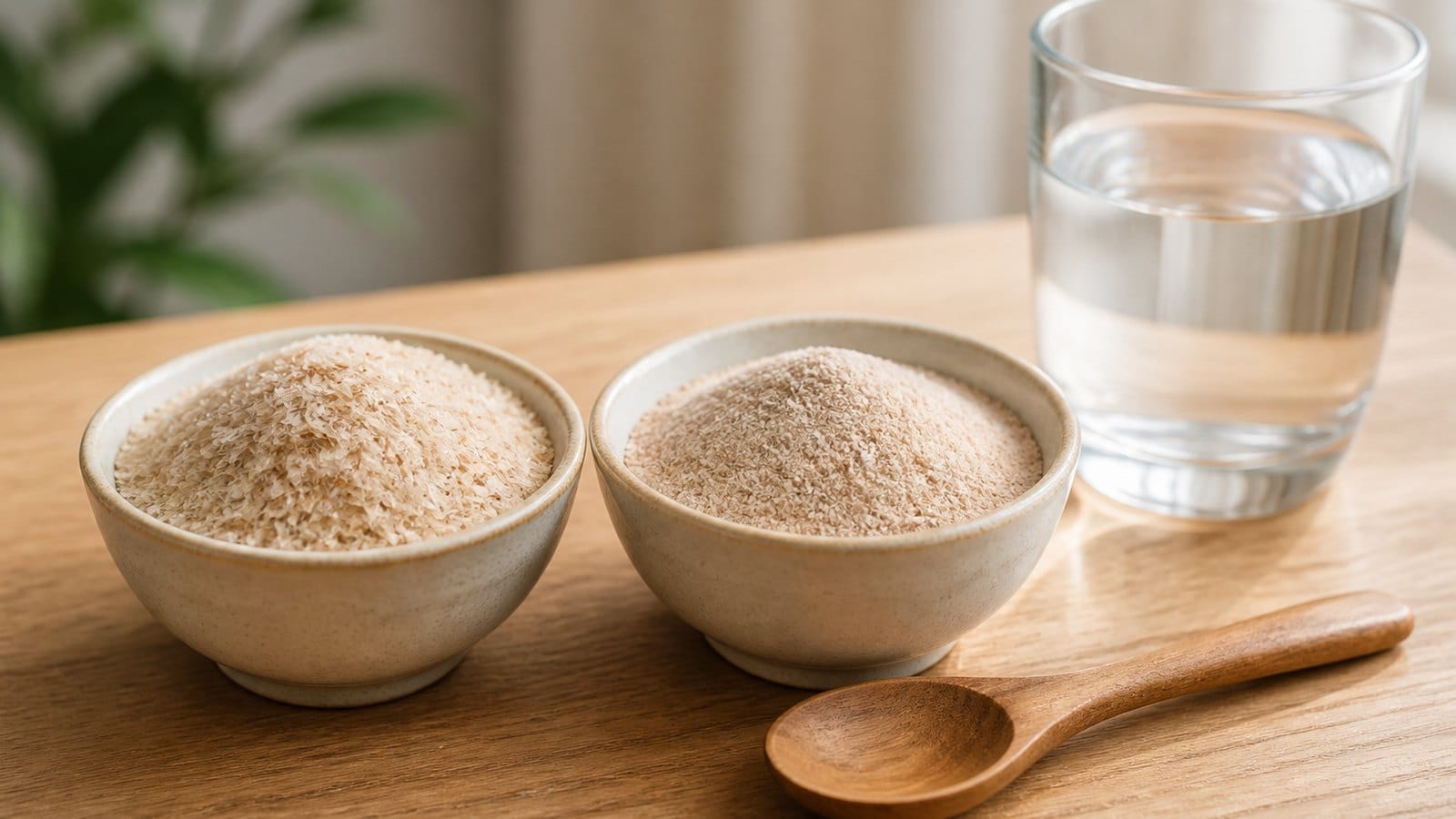
In short: Ground and whole are the same substance with the same effect. The difference is how quickly and how much the husks swell. Whole husks are the milder, more straightforward choice for your daily spoonful in water or muesli. Ground powder swells faster and forms a firmer gel, making it ideal for baking and thickening, but it needs to be drunk quickly.
| Whole Husks | Ground (Powder) | |
|---|---|---|
| Swelling | slower, loose gel | fast, firm gel |
| In a glass | easy to drink | thickens in seconds, can clump |
| In muesli/yogurt | good, slightly grainy | good, barely noticeable |
| For baking | less suitable | first choice (binds doughs without gluten) |
| Tolerance at first | usually gentler | may cause more bloating |
| Amount per spoon | looser, fewer grams | denser, more grams |
How they do not differ
Psyllium husks are the outer shells of the seeds of Plantago ovata. These husks contain the swelling agents that can bind many times their weight in water. Whether the husk stays whole or is ground makes no difference to this substance. If someone claims only the powder or only the whole husks have a certain effect, they're usually just selling one or the other.
What does change is the surface area. Powder has much more of it, so it absorbs water instantly and forms a denser gel. That's an advantage in baking, but a drawback in a drinking glass.
When whole husks are the better choice
- You stir them into water or juice and drink them. Whole husks give you a few minutes before they thicken.
- You're just starting out. Many people tolerate the slower swelling better at first.
- You sprinkle them over muesli, yogurt, or quark.
When ground powder is the better choice
- You bake gluten-free or low-carb. Powder holds together doughs that would otherwise fall apart.
- You want to thicken sauces, soups, or smoothies.
- You don't like the grainy texture of whole husks.
And capsules?
Convenient, but do the math: One capsule usually contains only about half a gram. For a typical daily amount of five to ten grams, that would be ten to twenty capsules. That's more expensive and rarely practical—unless you really can't handle the gel in a glass.
Psyllium seeds or psyllium husks?
This is often confused. Whole seeds contain the core, while husks are just the shell. The swelling agents are in the shell, so husks swell much more than whole seeds. For most purposes, when people say psyllium, they mean the husks.
How to take them correctly
- Start small: begin with a level teaspoon per day and increase over one to two weeks. Five to ten grams daily is typical.
- Drink plenty: at least one large glass of water per teaspoon, and ideally another one after. Without enough liquid, the husks won't swell properly.
- Drink powder immediately before it sets in the glass.
- Keep a gap with medications: one to two hours, as the swelling agents can delay absorption.
- Not suitable if you have swallowing difficulties or known intestinal narrowing. If you take medication long-term, check with your doctor or pharmacist first.
How to recognize good quality
- Purity of at least 99 percent. Anything less contains seed remnants and dust.
- Only one ingredient: psyllium husks. No sugar, no flavorings, no sweeteners.
- Organic quality and a lab analysis for pesticides and germs published by the manufacturer.
- A one-kilo bag is usually the best value per gram and keeps well if stored dry.
How psyllium husks compare to chia and flaxseed can be found in the big fiber comparison.
Frequently Asked Questions
Do I need to dose ground psyllium husks differently?
Not by weight. But a spoonful of powder weighs more than a spoonful of whole husks. If you switch, start with a little less.
Can I grind whole husks myself?
Yes, in a coffee grinder or a strong blender. Freshly ground works just as well.
When should I take them?
The time of day matters less than consistency and how much you drink. Many people take them in the morning.
How long do they keep?
Stored dry, cool, and sealed, usually well over a year. Powder absorbs moisture faster than whole husks.