The Years of Ibn Sina · Chapter 1. A new chapter every Thursday.
The summer of 980 weighed heavily over Afshana. According to the Islamic calendar, it was the year 370 of the Hijra. The village was made up of mud-brick houses, mulberry trees, and irrigation ditches, and on clear days you could see the smoke of Bukhara rising from its rooftops, half a day’s ride away. There, in the capital, sat Emir Nuh ibn Mansur, and from there came the orders that Abdallah carried every morning to the neighboring village of Charmaithan.
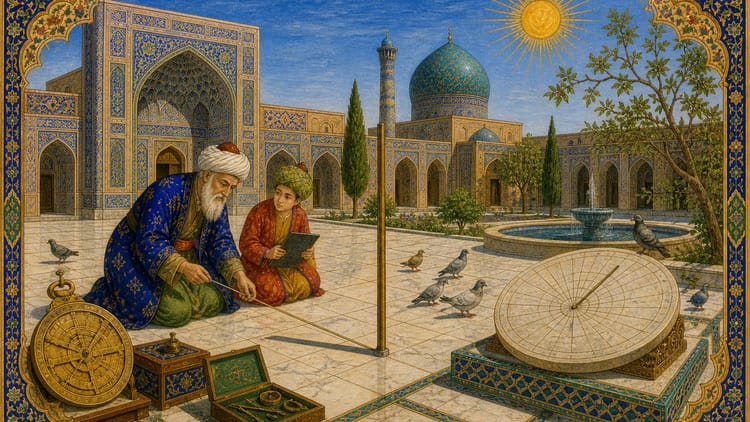
Abdallah was not a local man. He came from Balkh, far to the south, a city so ancient it was called “the mother of cities.” Like many learned men of his time, he had moved to Bukhara, for here people built, calculated, and wrote. The Samanids, who ruled the land, loved books almost as much as silver. On the markets, you could find paper from Samarkand, and in the scholars’ courtyards, people argued in Persian and Arabic about God, the stars, and numbers.
In Afshana, Abdallah had found a wife. Her name was Sitara, which means “star.”
The Night of Birth
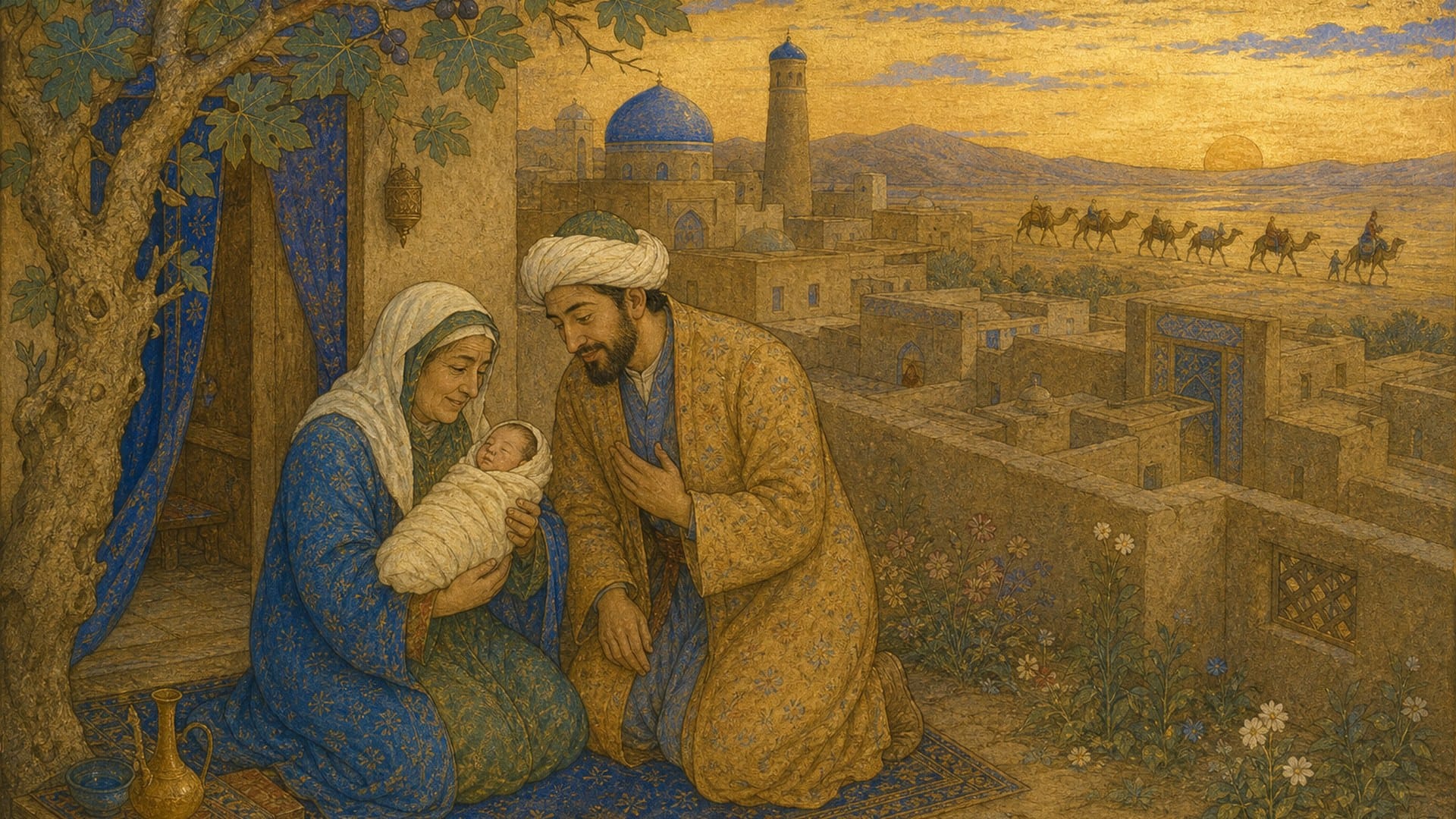
The labor began in the evening, when the heat finally eased. The village midwife, an old woman with hands like gnarled roots, sent Abdallah out into the courtyard. He paced beneath the fig tree, counted the stars, lost count, and started over.
Just before dawn, the house fell silent. Too silent. Abdallah stopped. Then, after a time that felt longer than the whole night, a cry cut through the darkness—thin, angry, and alive.
“A son,” said the midwife as she placed the bundle in his arms. “And listen to him cry. He wants something from this world.”
Abdallah named him al-Husain. Later, he would be called Abu Ali, and much later still, in lands no one in Afshana had ever heard of, people would mispronounce his name and call him Avicenna.
Bukhara
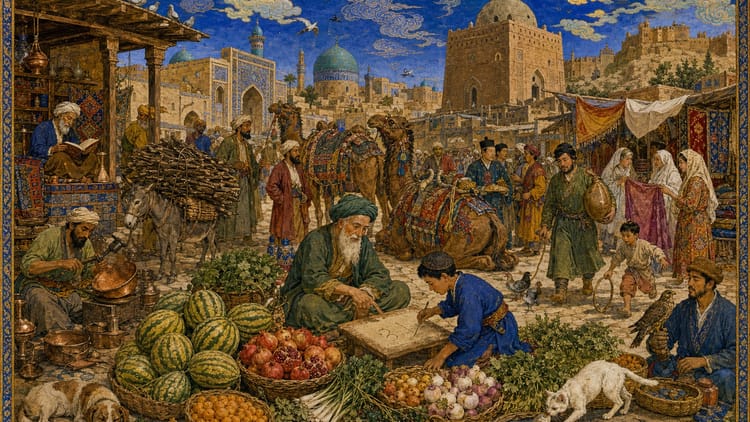
Five years later, al-Husain gained a brother, Mahmud. Soon after, the family moved to Bukhara. For a boy from the countryside, the city was a marvel: domes, caravanserais, camels from China and India, merchants shouting in languages he didn’t understand. And everywhere, people reading.
His father found him a teacher for the Quran and one for poetry. The boy learned so quickly that soon the teachers didn’t know what else to teach him. By the age of ten, he had memorized the Quran and much of the accompanying poetry. The adults were amazed. He himself didn’t think it was worth mentioning.
He found what happened in the evenings much more exciting.
The Guests
On some evenings, men came to his father’s house who spoke differently from everyone else. They belonged to a movement spreading its teachings from Egypt, and they talked about things you couldn’t touch: about the soul, about the mind, about what it is that truly makes a person alive.
Al-Husain was supposed to be asleep by then. Instead, he lay behind the curtain, his ear pressed to the fabric, listening. His father and Mahmud nodded along with what the guests said. The boy did not. He thought. Something about their answers didn’t add up.
One evening, one of the guests asked the group, “If the soul moves the body, where does it reside? In the heart? In the head? Or everywhere at once?”
Silence fell. The men looked at each other.
And behind the curtain, a ten-year-old boy drew breath to answer.
To be continued next Thursday: Chapter 2, “The Greengrocer and the Reckoning in the Dust.”
Body Knowledge from This Chapter: The First Breath
A newborn’s first cry is more than a sign of life. Before birth, the lungs are filled with fluid, and the baby receives oxygen through the umbilical cord. With the first strong breaths, the alveoli expand, the fluid is gradually absorbed, and the blood takes a new path: through the lungs. A small opening in the heart, which before birth bypassed the pulmonary circulation, closes—at first only due to the changed pressure. In just a few minutes, the body switches from water to air.
What Is True, What Is Story?
From Ibn Sina’s own autobiography: his father Abdallah from Balkh, his post in Charmaithan under Emir Nuh ibn Mansur, his mother Sitara from Afshana, his birth there, his brother Mahmud five years younger, the move to Bukhara, memorizing the Quran by age ten, and the guests who spoke about soul and mind and whom the boy listened to without agreeing.
Story: the midwife, the birth night, the dialogues, and the scene behind the curtain. The year 370 of the Hijra is documented, usually with the month of Safar; this corresponds to about August 980. An exact day is not known.
Source: The Life of Ibn Sina, critical edition and translation by William E. Gohlman, State University of New York Press, 1974.