
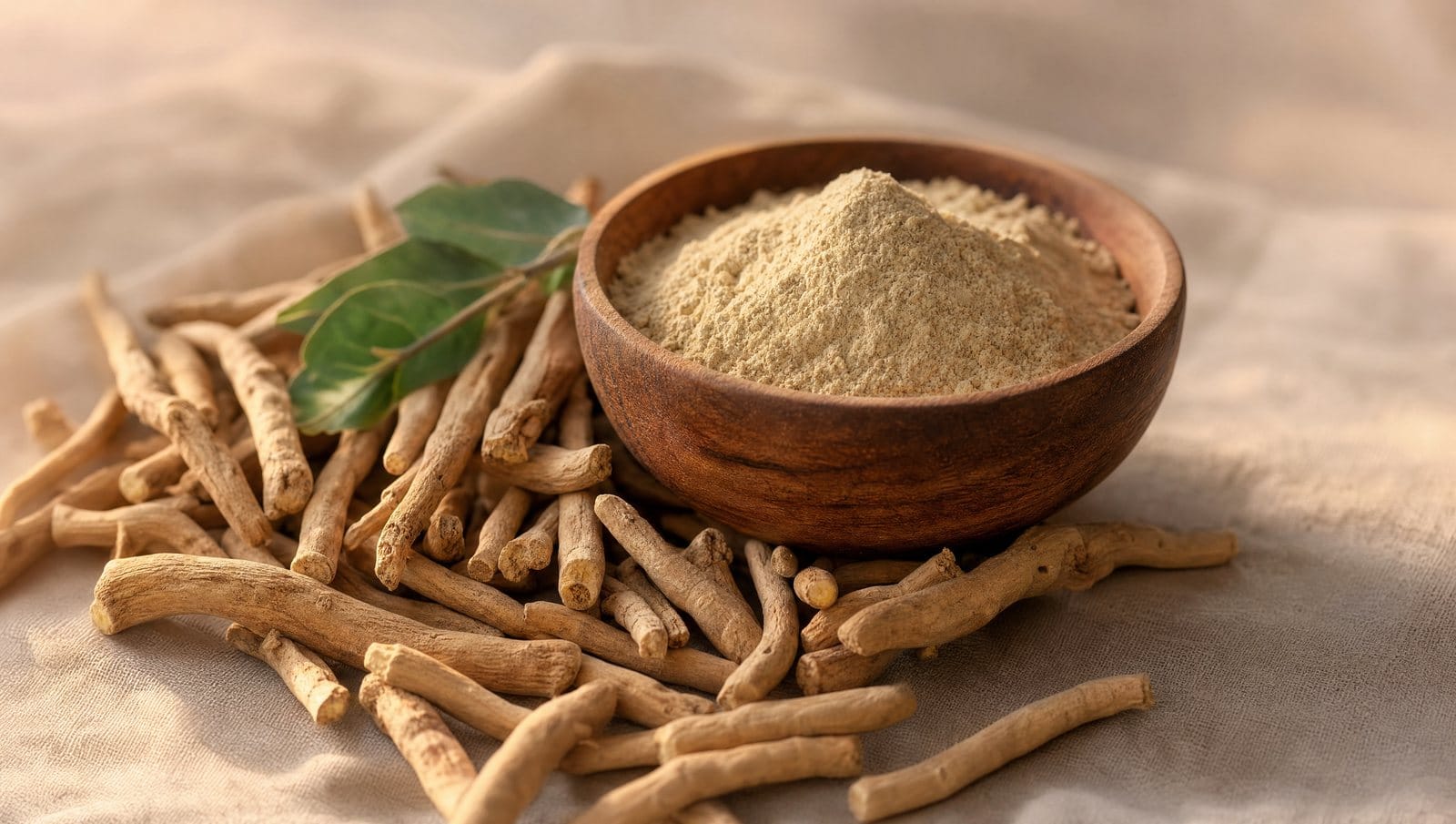
Why Ashwagandha for Sleep Problems?
Sleep disorders are among the most common health complaints of our time. Approximately one in ten adults in Germany suffers from clinically relevant insomnia, and even more struggle with difficulty falling asleep, frequent awakenings, or insufficient deep sleep. The causes are rarely purely organic – usually, it's stress that keeps us awake at night: thoughts race, cortisol levels remain elevated, and the body can't enter a state of rest.
This is precisely where the sleep-inducing berry, Withania somnifera, comes in. The Latin species name somnifera means "sleep-inducing" – Ayurvedic medicine has used the plant for at least 3,000 years as a nerve tonic and sleep-promoting adaptogen. What was long considered traditional healing knowledge is now also the subject of high-quality clinical studies. In this article, we will exclusively examine the new evidence regarding sleep – including a surprising meta-analysis from 2025 that raises an intriguing question: Does Ashwagandha truly reduce perceived stress, or only the cortisol biomarker?
Note: In calendar week 25, we already described the general mechanism of action of Ashwagandha. This article delves deeper and exclusively focuses on sleep quality and the latest meta-analyses from 2024/2025.
The 2021 Sleep Meta-Analysis: A Significant Overall Effect
The most important systematic review to date on the question "Does Ashwagandha help with sleep?" comes from Cheah and colleagues, published in 2021 in the journal PLOS ONE (PMID 34559859). It summarized five randomized placebo-controlled studies with a total of 400 participants. The result:
- Significant overall effect on sleep: Standardized Mean Difference (SMD) of −0.59 (95% confidence interval −0.75 to −0.42) – a moderate effect considered to be of relevant efficacy in clinical research.
- Strongest effect in diagnosed insomnia (vs. healthy adults with occasional sleep problems).
- Optimal range: Doses of 600 mg/day or more and a duration of at least 8 weeks.
This means that Ashwagandha is not a placebo-like herb, but rather has a measurable clinical benefit for people with genuine sleep problems – provided the dose and duration of intake are sufficient.
RCT by Langade 2021: Faster Onset, Longer Sleep
The more precise question of how Ashwagandha improves sleep is answered by a randomized controlled double-blind study by Langade and colleagues from 2021, published in the Journal of Ethnopharmacology (PMID 32818573). 80 participants – healthy volunteers and insomnia patients – took standardized Ashwagandha root extract or placebo daily for 8 weeks. The results for the verum group:
- Sleep onset latency significantly reduced (p < 0.0001) – the time it took to fall asleep significantly decreased.
- Sleep efficiency significantly improved (p < 0.0001) – the proportion of time actually spent sleeping in bed increased.
- Effect more pronounced in insomnia patients than in healthy individuals.
- Sleep quality (measured by the Pittsburgh Sleep Quality Index) significantly improved compared to placebo.
The clinical relevance is obvious: someone who takes 20–30 minutes longer to fall asleep will be measurably less rested the next morning. If Ashwagandha reliably shortens sleep onset time and increases sleep efficiency, overall nocturnal recovery benefits.
The Cortisol Paradox 2025: Biomarker Drops, Feeling Remains
A recent meta-analysis by Albalawi (2025) in the journal Nutrition and Health (PMID 40746175) is particularly interesting. It summarized 7 studies with 488 participants and found a remarkable paradoxical result:
- Cortisol significantly decreased – by −1.16 µg/dL (p < 0.001), a statistically clear effect.
- However, the subjective Perceived Stress Scale (PSS) did NOT significantly decrease (p = 0.40) – the subjects did not feel less stressed.
What does this mean for sleep practice? Cortisol is the central stress biomarker that blocks sleep at night: elevated evening or nighttime cortisol levels keep the body in an alert state, suppress REM sleep, and make it difficult to sleep through the night. If cortisol levels measurably decrease, sleep benefits – even if one doesn't subjectively feel "less stressed." The biomarker thus reacts more reliably than self-perception. This is an important insight for anyone who stops taking Ashwagandha because they "don't feel anything": the physiological effect on the HPA axis can still occur and be reflected in sleep architecture.
The overarching meta-analysis by Arumugam and colleagues (2024) in Explore (NY) (PMID 39348746) additionally confirms a significant reduction in the subjective stress scale (−4.72 points), the Hamilton Anxiety Scale (−2.19), and serum cortisol (−2.58 µg/dL) across 9 RCTs with 558 patients. The findings are therefore heterogeneous depending on the endpoint – but overall, they clearly point to a beneficial effect on the stress axis relevant to sleep.
Practical Application: Dosage, Quality, and Safety
The study data provides a clear picture for practical application:
- Standardized root extracts with ≥5% withanolides are superior to simple powders. KSM-66® is the most thoroughly studied full-spectrum extract.
- Daily dose of 300–600 mg of standardized extract, divided into morning and evening. For sleep, evening intake 30–60 minutes before bedtime is particularly important.
- Continue for at least 8 weeks – efficacy builds up slowly, and placebo-like effects in the first 1–2 weeks are normal.
- Evening intake can be wonderfully combined with a warm "Moon Milk" – see our recipe for golden Ashwagandha milk.
💡 Recommendation [Advertisement | Affiliate Link]: High-quality organic Ashwagandha KSM-66 with 600 mg root extract and 5% withanolides can be found at Amazon.de – Ashwagandha KSM-66 Organic Capsules. Look for organic quality and avoid fillers.
Safety Notes
- Not for use during pregnancy and breastfeeding – possible uterotonic effect.
- Thyroid patients should consult their doctor beforehand – Ashwagandha can increase T3/T4.
- Interactions with sedatives, blood pressure, and thyroid medications are possible.
- In studies, Ashwagandha was well tolerated; mild gastrointestinal discomfort is the rarest side effect.
Conclusion: Sleep-Inducing Berry with Scientific Backing
Current research confirms what the species name somnifera promises: Ashwagandha measurably improves sleep onset latency, sleep efficiency, and sleep quality – especially in people with diagnosed insomnia. Particularly insightful is the finding from the Albalawi meta-analysis 2025 that the cortisol biomarker reacts more reliably than subjective stress perception: those taking Ashwagandha for sleep should therefore not rely on their feelings, but give the physiological effect 8 weeks to work – ideally measurable via a sleep diary or wearable.
In combination with basic sleep hygiene – a consistent rhythm, no caffeine after 2 PM, screens off after 9 PM – Ashwagandha is one of the best-supported herbal options for restful sleep.
Disclaimer: This article is for informational purposes only and does not replace medical advice, diagnosis, or treatment. For chronic sleep disorders, pregnancy, thyroid conditions, or medication use, please consult a doctor before use.
→ To the recipe: Golden Ashwagandha Milk with Turmeric & Cinnamon